Interpeace et le Centre d'études pour la paix et le développement (CEPAD) have worked together since 2007, supporting peacebuilding processes in Timor-Leste. Our partnership began in response to the violent political crisis of 2006, which revealed the challenges of a young nation adopting a new system of state structures. Throughout the years, we used Participatory Action Research (PAR) and piloted innovative approaches to assessing local resilience (Frameworks for Assessing Resilience) to help break cycles of violence and create a safe environment for the Timorese. This work enabled bottom up and locally owned solutions to be formulated, to identify and address local grievances in a non-violent and sustainable manner. CEPAD is now considered a “go-to” organization for peace and development challenges, and is recognized for promoting inclusive democracy by providing safe spaces for community dialogue.
In 2019, a case study of Interpeace’s long-standing partnership with CEPAD was developed as part of the Stopping As Success (SAS) initiative – a collaborative learning project that aims to study and provide guidelines on how to ensure locally led development and peacebuilding. The SAS initiative touches on many of the core principles Interpeace was founded on – local ownership, long term commitment, process-oriented work and the primacy of trust as a keystone to peace. ‘Success’ in locally led peacebuilding work can be defined in many ways, and an organizational or programmatic exit of an INGO or International Organization in lieu of successful and sustainable local organizations is one important indicator. However, a larger understanding of ‘success’ in locally owned peacebuilding ought to ultimately be about whether the broader social contract is moving towards peace. As peacebuilders, Interpeace and our partners always aim toward that ultimate goal.
In order to achieve sustainable peacebuilding processes that reinforce a peaceful social contract we have long known local ownership and not internationally driven approaches is key. While this has long been recognized, operationalizing local ownership of peacebuilding remains an ongoing challenge. That is why the SAS case study ,“Centre of Studies for Peace and Development (CEPAD) and Interpeace: A partnership transition in Timor-Leste”, is an instructive example of the practical steps international actors can take to support the efforts of a locally led organization developing locally owned and inclusive peacebuilding solutions.
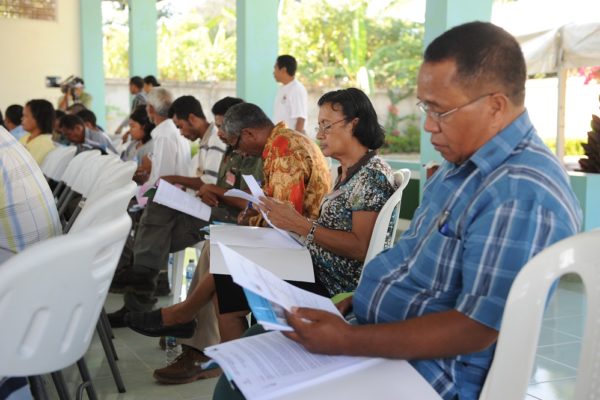
CEPAD Timor-Leste. Photo credit: Steve Tickner 2009
Fostering local ownership through sustainable partnerships
For over 25 years, Interpeace’s approach has made sure that local people are at the heart of building peace. We believe that peace must be built from within societies and not imposed from the outside. Therefore, from the outset of our partnership with CEPAD, we put our trust in our partners local teams to lead the strategic management and implementation of project activities. Interpeace provided ongoing technical , financial and capacity-building support to CEPAD, since its creation in 2007. However, in 2015, Interpeace began a process to phase out its financial support to remain engaged with CEPAD solely in an advisory capacity. While Interpeace provided financial and technical support as well as supported the development, implementation and evaluation of projects, delivered ongoing training to CEPAD staff, CEPAD was in the driver’s seat.
A CEPAD staff member mentioned, “Interpeace stopped the funds in 2016 but the relationship continued. Whenever we have any difficulties, we contact Interpeace and get their ideas and comments on our work and situations that we are facing.”
The case study developed by SAS captures how Interpeace’s approach – working with local partners and committing to long-term engagement – is critical to ensure sustainable peacebuilding efforts. It highlights that the trust that was built during almost a decade between Interpeace-CEPAD, helped both organizations as Interpeace transitioned away from providing financial support.
A number of key lessons were also mentioned by the case study: a.) strong leadership is an important factor when creating and sustaining an NGO that can operate successfully when financial support from an INGO partner ends; b.) adopting bottom-up, locally led models from the outset – as opposed to time-bound, top-down projects – contributes to a more sustainable transition process; and c.) it is possible for INGOs to find creative ways of continuing to support locally led organizations and initiatives after transitions have concluded.
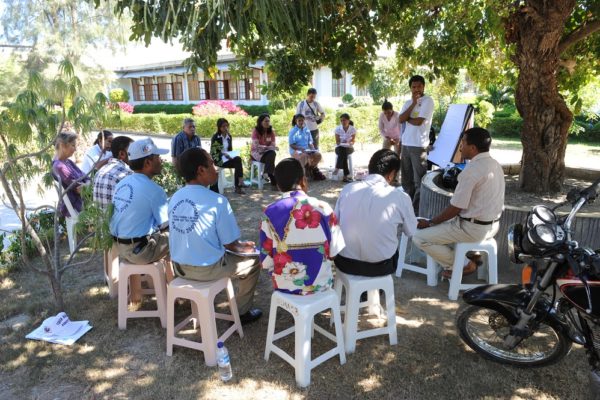
CEPAD Timor-Leste. Photo credit: Steve Tickner 2009
Read the full case study or 2-page summary
Members of national and international civil society organizations operating in Somalia have voted Interpeace as the chair of a multi-agency peacebuilding working group. The Somalia NGO Consortium made the announcement on 27 January 2020.
Somalia NGO Consortium (SNC) is a voluntary coordination mechanism of national and international Non-Governmental Organizations (NGOs) working in Somalia and operates in Somaliland. The Consortium was established in 1999.
Interpeace will lead the Peacebuilding Working Group for a period of one year, together with Saferworld as co-chair. The peacebuilding group is one of 6 thematic working groups established by the Consortium to effectively coordinate and conduct development and humanitarian support in Somalia.
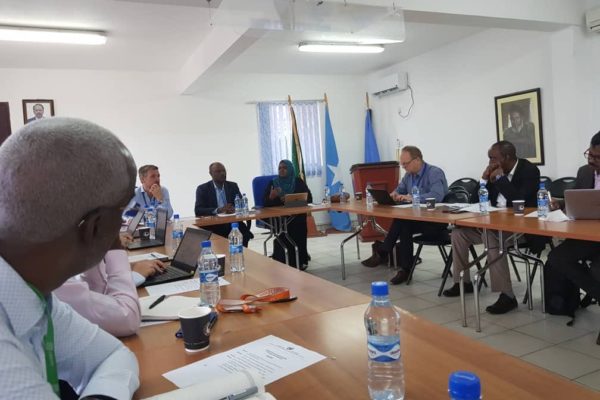
NGO Consortium members in session. Photo credit: NGO Consortium.
Our team in Somalia and Somaliland has welcomed the news with delight and expressed their commitment to work closely with many other organizations to improve social cohesion, community safety interventions and effectively build sustainable peace in Somalia.
“We are indeed excited and pleased to be coordinating and working in a cohesive way with our peer organisations,” said Ahmed Abdullahi, Interpeace’s Somalia Country Coordinator.
“This platform gives us the opportunity to shape and advance innovative approaches to address the root causes of violence and work on restoring trust between communities,” said Mr Abdullahi.
We can only build a more peaceful future through collaboration. Working together as a group within the consortium strengthens our work as a peacebuilding community to effectively contribute to Somalia’s vision for change.
The Somalia Peacebuilding Working Group is an opportunity to consolidate partnerships, build a stronger peacebuilding community in Somalia and demonstrate to the world that we are more efficient when we work together.
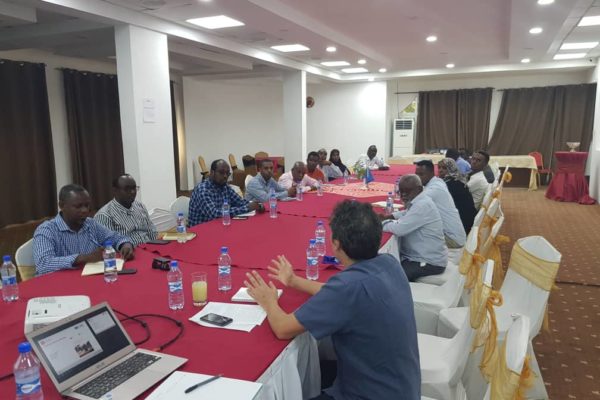
NGO Consortium members in session. Photo credit: NGO Consortium.
In many armed conflicts around the world, borders are an important but often poorly understood feature. Conflict dynamics on one side of a border often have an impact on the other side. Despite this transnational nature of conflict, peacebuilding interventions have often focused on areas within a country – and often face difficulties operating on both sides of a border.
The regional programme of Interpeace is taking peacebuilding across borders in Africa’s Great Lakes region. The regional programme supports cross-border peace initiatives together with our partners, Never Again Rwanda (NAR) in Rwanda, Centre d’Alerte et Prévention des Conflits (CENAP) in Burundi, Pole Institute et un Centre d’Etudes Juridiques Appliquées (CEJA) in North Kivu as well as Action Pour la Paix et la Concorde (APC) et un Reseau d’Innovation Organisationelle (RIO) in South Kivu, Democratic Republic of Congo(DRC).
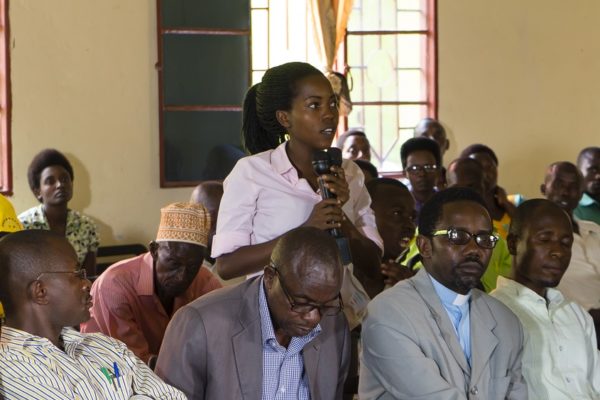
Cross-border dialogue programme. Photo credit: CENAP
Working in border communities between Burundi, Rwanda, Uganda and DRC’s North Kivu and South Kivu, our Great Lakes programme has supported numerous activities that have addressed cross-border conflict drivers and improved the resilience of communities living near the borders. The programme has also contributed to a strong collaboration of civil society organisations in three countries which would have been unlikely if it were not for this programme. This is sustained through frequent coordination and collaboration.
That is why, from 27 to 31 January 2020, 35 peacebuilders from Burundi, Rwanda and the Democratic Republic of Congo (DRC) met in Nairobi, Kenya to discuss coordination of our efforts in 2020 to rebuild trust, resilience and advance social cohesion in the Great Lakes region. The meeting was facilitated by our regional programme.
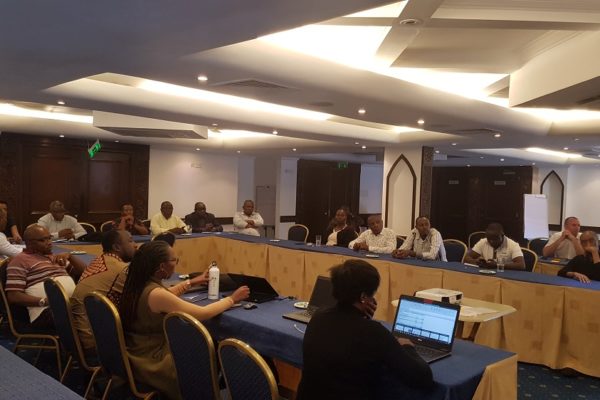
Great Lakes coordination meeting in Nairobi. Photo credit: Jude Fuhnwi
“This meeting was highly important for our partnership,” said Eric Mahoro, Deputy Director of Never Again Rwanda (NAR). “For any partnership to be effective, there is need to plan and think together. This is what strengthens the spirit of working together, the openness required for sustainable partnership.”
Cross-border dialogue is important to strengthen social cohesion in this region, but often, countries act separately to resolve cross-border rooted conflicts. In the last four years, our Great Lakes programme has facilitated inclusive and participatory cross-border dialogues that have contributed to the transformation of violent persons into peace actors, restored trust in communities and fostered social cohesion.
“Permanent spaces for dialogue across borders have nourished fruitful interactions that led to advocacy in communities on problems experienced locally, related to population movement across borders and their living conditions in the different countries,” explained Daniella Niteka, Researcher at Centre d’Alerte et Prévention des Conflits (CENAP) – a conflict prevention organization in Burundi.
“In Cibitoke, dialogue was used to help repatriate Burudians who lived in difficult conditions in South Kivu on the other side of the border in DRC,” said Daniella.
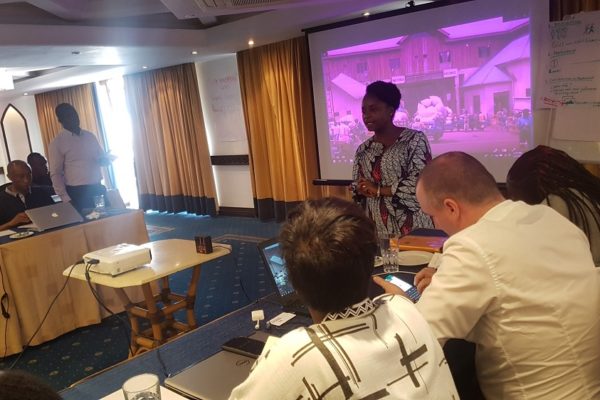
Great Lakes coordination meeting in Nairobi. Photo credit: Jude Fuhnwi
The spaces for dialogue bring together people from across the border, offers them the chance to work and reduce stereotypes, and increases cooperation between people of these countries irrespective of what goes on at high political level. Some of the spaces have come up with resolutions that are used to engage official decision makers locally at the border level and even at a higher level.
According to Mr Mahoro, “the local leaders’ association of Francophone mayors has been instrumental in increasing understanding of decision makers on border issues, inviting them to multiply efforts to deal with problems they face in border communities.”
Interpeace’s programme in the Great Lakes has also facilitated conflict prevention dialogues related to the management of waters between countries in the region and cohabitation among border populations. Our peacebuilders have carried out research on land, power and identity related conflicts, as well as on resilience for reconciliation in the volatile political context. The programme empowers people to resist manipulation and be resilient in the conflict situation.
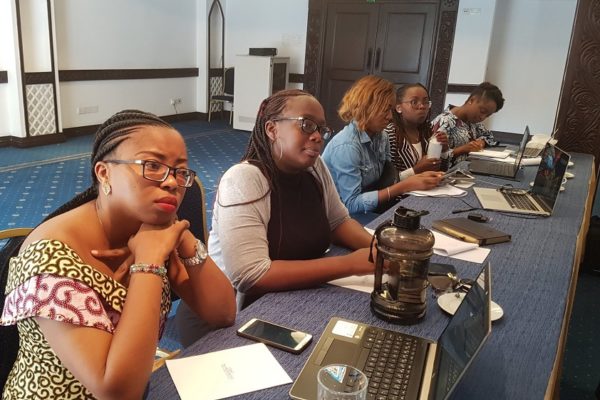
Great Lakes coordination meeting in Nairobi. Photo credit: Jude Fuhnwi
The meeting in Nairobi discussed the future of the programme and how to build on the lessons learned and successes of the last four years. It also discussed priority areas and the importance of ensuring that local communities are increasingly involved in the cross-border peacebuilding initiatives.
“We looked at significant changes from the different locations that we can be proud of. We’ll continue with the work to elevate the impact we have achieved at local level,” said Dr Theo Hollander, Interpeace’s Senior Representative for Eastern and Central Africa.
Interpeace has scaled up its programmes in West Africa to support ongoing peace efforts in the troubled Sahel region. Our nationwide peacebuilding programme in Burkina Faso was officially launched on Thursday, 6 February 2020 in the capital Ouagadougou.
“This programme will support social cohesion and consolidate peace through inclusive and participatory dialogues, from the community to political level,” said Alessia Polidoro, Interpeace’s Senior Representative for West Africa.
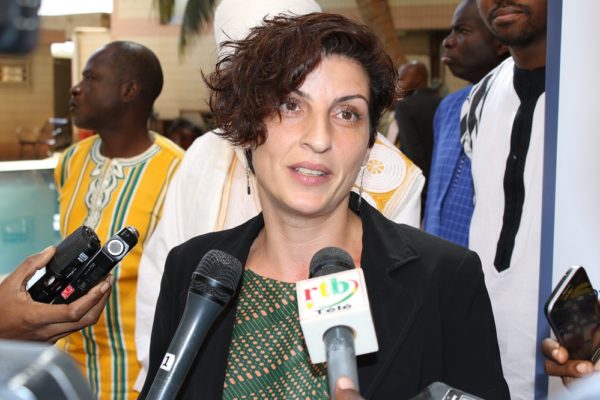
Alessia Polidoro, Interpeace’s Senior Representative for West Africa. Photo credit: Interpeace
Burkina Faso is hard-hit by the worsening violent conflicts in the Sahel. Having a deep understanding of the complex dynamics and actors of these conflicts will be at the heart of Interpeace work in the country.
A team of national researchers from Interpeace is already facilitating a locally owned, driven and led process to conduct an analysis of what drives violence in Burkina Faso and identify existing factors of resilience. The programme’s goal is to promote a culture of inclusive and participatory dialogue that builds trust between different actors in conflict, and effectively respond to the challenges to peace and social cohesion.
“We welcome Interpeace to implement this project. It is innovative in approach from local level where all strata of society will express themselves and give their opinions on the root causes of the current security and social situation,” said Vincent Sawadogo, minister’s representative and Director of Cabinet at Burkina Faso’s Ministry of Territorial Administration, Decentralisation and Social Cohesion.
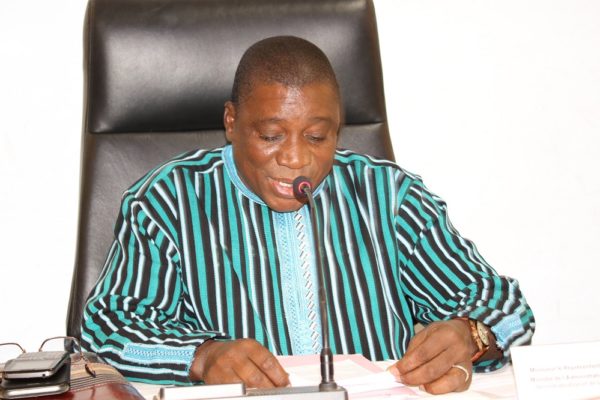
Vincent Sawadogo, minister’s representative and Director of Cabinet at Burkina Faso’s Ministry of Territorial Administration, Decentralisation and Social Cohesion. Photo credit: Interpeace
He added: “I invite Interpeace to implement this project with all rigour. The government is ready to actively participate in the implementation of recommendations. The government is available, especially my ministry to support this process.”
While only a fraction of young people in Burkina Faso contribute to violence, the common stigma of youth as perpetrators of violence, especially in the media space, remains a shield to the potential of the majority driving substantial positive change in their societies.
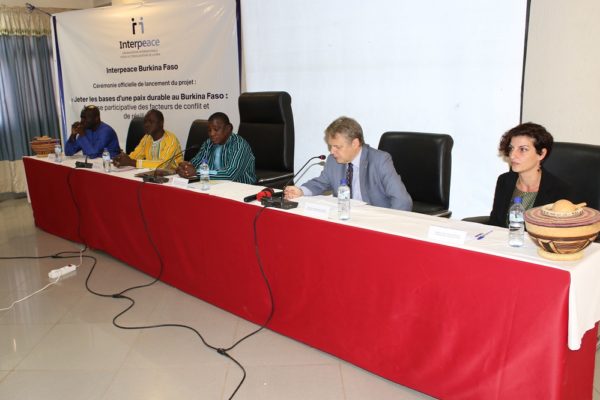
Burkina Faso programme launch. Photo credit: Interpeace
Recognizing youth as key players who can bring change and stability to societies in Burkina Faso, our programme has partnered with Fondation Hirondelle to strengthen mutual understanding and trust between young Burkinabès, who often feel isolated from and frustrated by national decision-making processes – and have become the main victims of radicalisation and violence.
“The peacebuilding work envisaged by Interpeace is pertinent. We hope that this programme launched today will initiate the right approach to conflict resolution in Burkina Faso,” said Ousmane Nassourou Dicko, the Emir of Liptako, a region in eastern Burkina Faso.
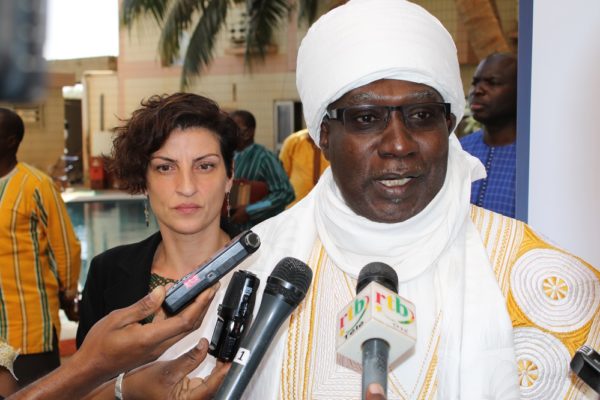
Emir of Liptako. Photo credit: Interpeace
There is hope that the surge in violent attacks in communities near the Kenya-Ethiopian border is close to being contained. Local leaders have committed to end violent activities linked to extremist groups and communal disputes over land and other meagre resources.
The resolution was announced in a joint statement by government leaders, community elders, religious leaders, elected leaders, representatives of parties to conflict, security officials and various peace actors in that administrative region. In the declaration made public recently after a two-day symposium on preventing violent activities, the leaders agreed to champion local solutions for peace to reign in Mandera County.
“We the leaders and people of Mandera County realize that our common aspirations and prosperity lie on the immediate, firm and resolute action against the threat of violent extremism, radicalisation, inter-clan clashes and poverty,” the declaration reads in part.
Since 2014, Mandera county has been at the forefront of deadly attacks by terrorist groups and armed local militia carrying out raids and counter-attacks mainly on ethnic lines – which means the communities are not only exposed to insecurity, but have also lost a chance to live together in harmony.
The decision by Mandera County leaders to end all forms of violence has been welcomed by Interpeace in Kenya as proof that lasting solutions for peace require local ownership.
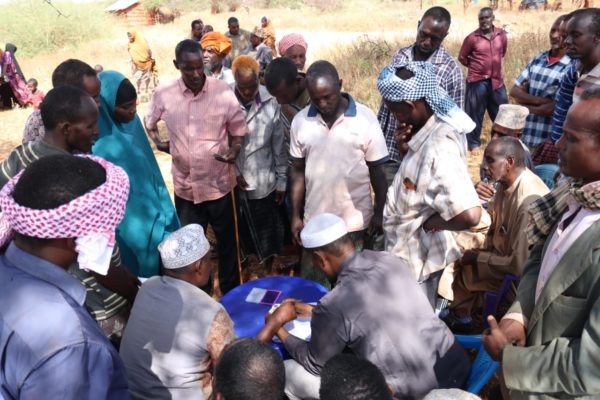
Mandera County leaders. Photo credit: Interpeace
“Peace cannot be imported from outside. Meaningful and sustainable conflict resolution requires bringing together everyone and ensuring that they participate in the process. That’s what we see happening in Mandera county now. It is a laudable initiative,” said Hassan Ismail, Interpeace’s Kenya Country Representative.
More communities in Kenya should openly express, in their own terms, how they understand threats to peace and security in their areas and act to address these challenges, emphasized Mr Ismail.
He added: “Mandera communities are setting an example and we at Interpeace together with our partner the National Cohesion and Integration Commission of Kenya (NCIC) remain committed to supporting the implementation of these resolutions to foster a culture of peace and promote social cohesion”.
Interpeace and NCIC in partnership with the County Government of Mandera has resettled 1,970 households in Banisa Sub County, that were displaced recently following the killing of 19 persons in attacks linked to cross border revenge on the Kenya-Ethiopia border. The resettlement process started in December 2019 after the signing of a ceasefire agreement between the Garre and Degodia community.
Since 2016, NCIC and Interpeace have carried out research in consultation with communities in Mandera County, identified several barriers to peaceful coexistence and are now supporting peace processes to address violent conflict and sustain peace in the long term.
Currently, Interpeace and NCIC are setting up a regional peace and cohesion centre in Mandera to support cross-border peace initiatives.
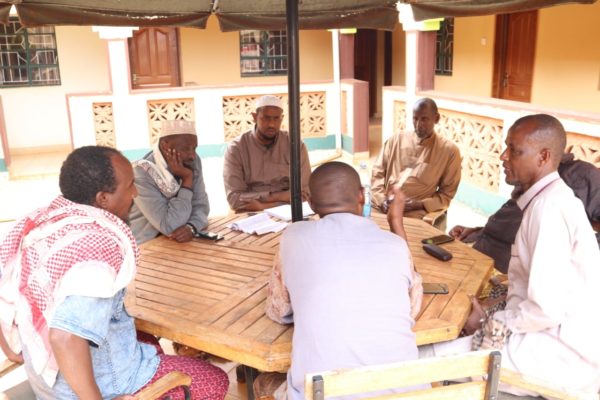
Mandera County leaders. Photo credit: Interpeace
It is 11:37am in Muhanga, a town in the southern province of Rwanda and a group of 24 women have gathered despite the drizzle, to welcome a delegation of Interpeace and Never Again Rwanda. These women have all experienced a tragic past, but it’s not until you start talking to them, that this becomes evident. Their testimonies bring to the surface a tragedy that struck their country 25 years ago – the 1994 Genocide against the Tutsis in Rwanda.
Clarisse (not her real name) is a Tutsi woman in her early 50s who married a Hutu husband. They had five children and lived happily together before the genocide brought calamity and hardship to her life. Clarisse’s husband was brutally murdered for marrying a Tutsi, but she escaped death with her children.
However, life for Clarisse after the genocide was unbearable. Living without a husband meant she had to assume unfamiliar roles in a very harsh society, where social cohesion had been disrupted by violent conflict.
“I was rejected by my family because they felt that I had betrayed their trust by marrying a Hutu man. On the other hand, my husband’s family rejected me because they felt that I was the root cause of my husband’s death,” said Clarisse.
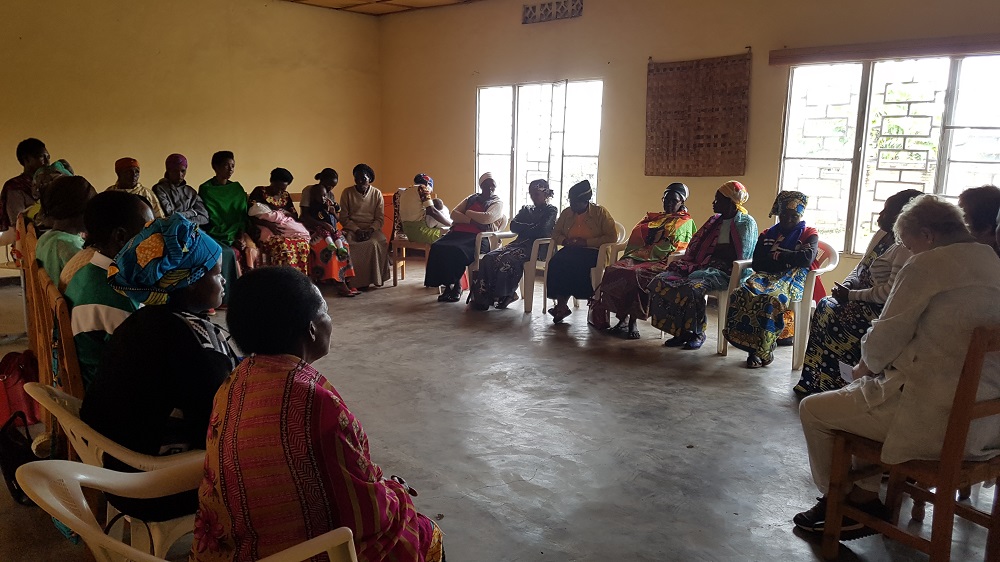
Muhanga, Rwanda. Photo credit: Jude Fuhnwi
Like many survivors of the genocide against the Tutsis, society rejected Clarisse. She explained that people around her interacted, shook hands and hugged each other, but when it came to interacting with her, they just waved. “To make matters worse my children became rebellious against me and I developed hatred towards them,” she added
As the rejection and stigma deepened, Clarisse became depressed and attempted to take away her own life on different occasions. Clarisse was not alone. Many survivors of the genocide shared similar or even worse experiences.
“I was silent about what was happening to me and had a lot of self-hatred. I am Hutu and was married to a Tutsi. Got a lot of hatred from my family. His family did not accept me either. I transferred all the hatred to my child, and he hated me because I had no family. I was going to commit suicide,” explained Anne, another member of the group who survived. “But the psychotherapist supported me. We had a joint session with my child, and she explained to him that it was not my fault,” she added.
A mental-health survey from Rwanda’s Ministry of Health in 2018 showed that genocide survivors suffer a higher prevalence of depressive disorders, post-traumatic stress, panic and drug abuse than the population as a whole.
Interpeace and its partner in Rwanda, Never Again Rwanda (NAR) have been supporting the healing and reconciliation process in the country for many years. In 2015, we began implementing the societal healing and participatory governance programme funded by the Swedish International Development Cooperation Agency (SIDA) and the European Commission.
Since then, the societal healing and reconciliation component of the programme has created 15 spaces for peace, where people in different communities across Rwanda openly discuss the sensitive past of the country and related psychological wounds.
When Clarisse was called to join the group in Muhanga, she came with fear that everyone would isolate her. But her worries were misplaced.
“I was welcomed with open arms not only by the facilitators but group members as well. Through listening to group members’ testimonies, I learned to accept myself, acknowledged what I went through and began my healing journey,” said Clarisse, adding that “today I no longer feel hurt by what other people think about me. Instead of showing anger towards them, I express love.”
These spaces have opened dialogue between people in the communities, reconciled many and empowered them economically. The spaces are co-facilitated by NAR psychotherapists and peace agents selected from the communities.
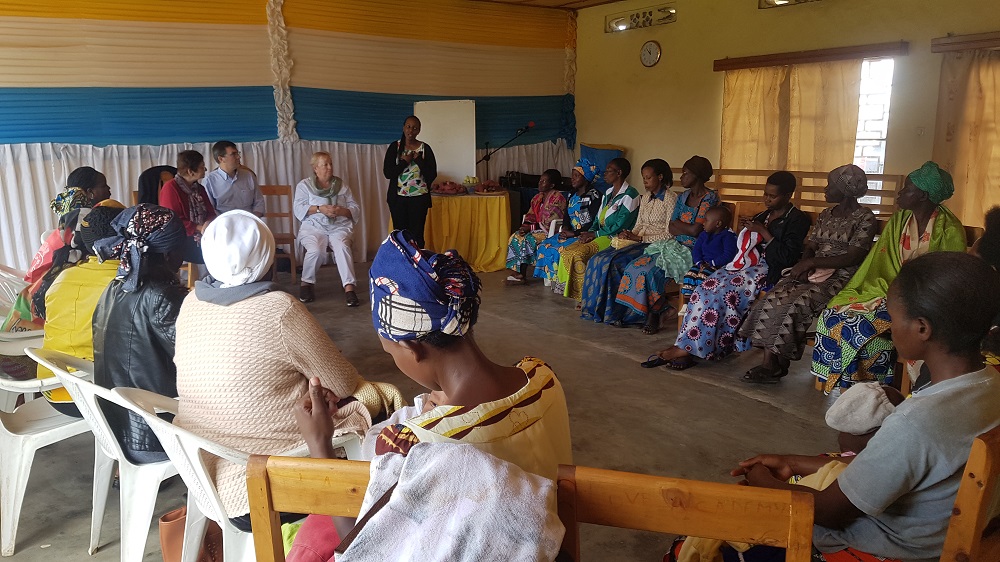
Muhanga, Rwanda. Photo credit: Jude Fuhnwi
Our spaces for peace project in Muhanga ended in 2018 after supporting 30 women, aged between 27 and 65, to heal from wounds of the past. However, these beneficiaries have continued to meet after the project phased out.
“We draw our strength from each other. We are on a journey and we must continue,” said a member of the group when the Interpeace and NAR delegation visited on Wednesday, 4 December 2019.
On their own initiative, they are helping each other to heal and empowering group members through income generating activities.
“They established 3 smaller groups for members based on their proximity. Each of these groups developed an income generating activity to support their economic needs and still continue to engage in discussions for healing,” said Emelienne Mukansoro, Never Again Rwanda’s Psychotherapist in Muhanga.
Members of the group have taught each other different skills in embroidery and market gardening, work together and share proceeds from the sale of their produce.
“We use our hands to become productive and our hearts to feel peaceful,” said one member of the group. Another one added: “We have built ourselves up and will keep going by helping other women to do the same”.
Depressive disorders and post-traumatic stress have damaging effects on societies. Interpeace and NAR have continued to work with Rwandan authorities, the Ministry of Health and communities to support mental health and trauma healing to advance social cohesion in Rwanda.
“It’s been very inspirational, powerful testimonies. They are doing amazing work on mental health and we in Northern Ireland have much to learn from Rwanda on this,” said Monica McWilliams, Chair of Interpeace Governing Board.
Interpeace and the Rwanda Ministry of Health met in Kigali with local and international partners on 4 December 2019, to discuss a scale up of our work on mental health and trauma healing to nurture social cohesion. This new programme will provide psychosocial group support therapy at all administrative levels in Bugesera District, which was hard-hit by the genocide. It will also innovatively introduce mental health support at the level of individuals with particular needs, as well as offer life and vocational skills training, as additional elements contributing overall to social cohesion.
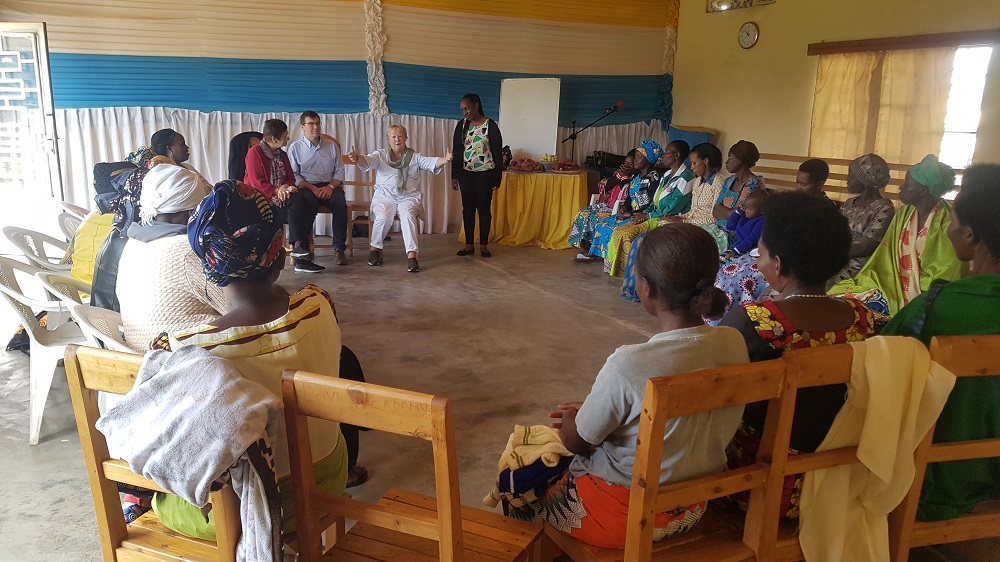
Muhanga, Rwanda. Photo credit: Jude Fuhnwi
*Names of victims changed or not mentioned for privacy reasons